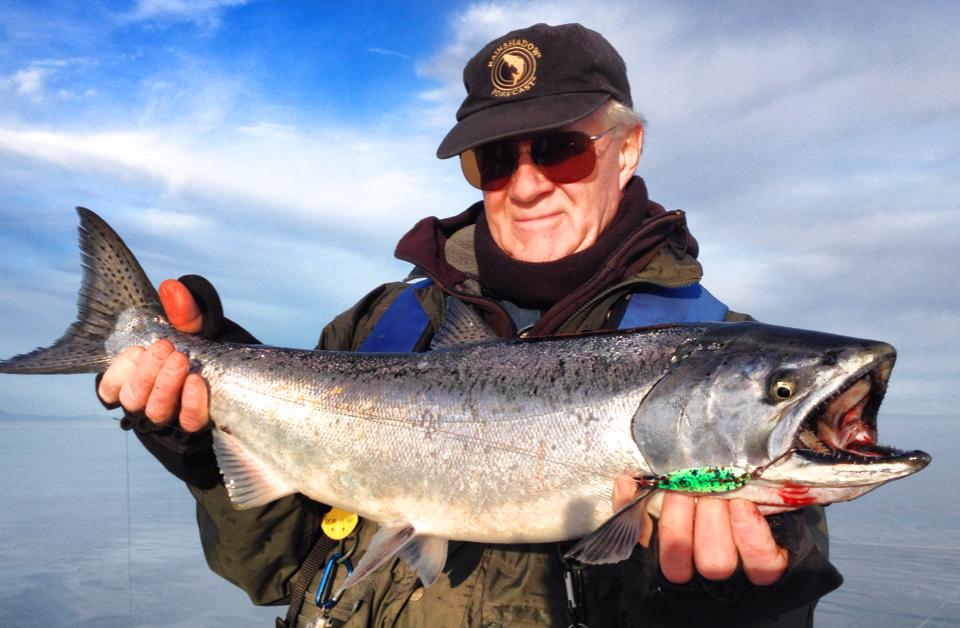
WDFW Proposal to Reduce Chinook Size Limit to 20 inches

Thursday night I sat in on the North of Falcon meeting held at the North Olympic Chapter of Puget Sound Anglers. Many issues were discussed but one really caught my attention — a size reduction for winter blackmouth from the current minimum size of 22 inches to 20 inches. Please read the handout from Washington Department of Fish & Wildlife. WDFW wants your comments and welcomes them on this subject. Please click here <<< after reading the fact sheet below and submit your thoughts and opinions. Remember, if you don’t speak out you will never be heard. My opinion will be below the fact sheet.

Puget Sound Chinook Winter Minimum Size Limit Reduction Fact Sheet

Background:  The minimum size limit for Chinook retention has varied widely during the history of the Puget Sound sport fishery. It was 12 inches in the 1930’s, no size limit in the 1970’s, size limit of 20 inches in the late 1970’s and has remained 22 inches (today’s limit) since 1983. The current size limit (22 inches) was designed to help achieve 50:50 harvest sharing between state and tribal fisheries. The idea of reducing the size limit has been proposed by anglers for many years with options ranging from year-round size limit reductions to reductions only within winter blackmouth and/or mark-selective fisheries (MSF). The majority of the support is for winter MSF’s only.

1) Modeling of the size limit change has been approved

In 2013 the Pacific Fishery Management Council approved the changes necessary to properly model size limit changes in the Fishery Regulation Assessment Model (FRAM).

2) Size limit reductions will have a negligible impact on ESA-listed Chinook

Preliminary modeling indicates that reducing the minimum size limit from 22 inches to 20 inches during winter MSFs (Mark-Selective Fisheries) will not measurably increase ESA impacts, because these are mark-selective, hatchery-directed fisheries.

3) Recreational fisheries will see an increase in the number of allowable encounters

The abundance and size structure of fish present in the Puget Sound in any given year is variable, but on average reducing the size limit to 20 inches may translate into a 30% increase in what’s considered to be legal to keep during winter MSFs and a 10% increase during summer fisheries. These estimates are based on test fishery length-frequency data and correspond well with FRAM predictions.

4) Released fish have a very low chance of being caught again

The loss in future access to big Chinook (age 4-5) due to the increased harvest of small blackmouth (mostly age 2) is minimal due to the natural mortality that will occur anyway (e.g., 50% chance of surviving from age 2 to 5 in the absence of fishing and maturation), combined with the relatively small contribution to total fishery-related mortality arising from current fisheries. For these same reasons, it is unlikely that any increase in harvest of 20-22 inch fish during winter MSFs will cause an evolutionary change (e.g., toward younger maturation) in the targeted hatchery populations.

5) Monitoring fisheries will continue so that changes are well understood

Given that it has been nearly 20 years since the minimum limit was less than 22 inches, it will be necessary to monitor fisheries subject to this potential regulation change at a level that’s sufficient to measure changes in total fishing effort, angler behavior (e.g., compliance, voluntary release), catch success, and stock exploitation patterns. The sampling programs already in place for our intensively monitored mark-selective fisheries are sufficiently rigorous to provide this insight, but new approaches may also be considered.

6) Reasoning for reducing the size limit to 20 inches during winter fisheries

Reducing the minimum size limit to 20 inches will allow for more successful trips. It will allow anglers to access a greater fraction of the hatchery production that they help to fund through license fees, while simultaneously reducing the number of hatchery strays on spawning grounds. Increased harvest in non-treaty sport fisheries will help restore 50:50 sharing of allowable catch where inequities are perceived. End of WDFW draft 3/2/2015

Click Here <<< to submit your online comments regarding this and other possible changes in Washington State’s sport fishing rules and regulations.

My thoughts: Please note, this fact sheet clearly shows that recreational anglers are not reaching their 50 percent total harvest. In other words, the tribes have been catching more than 50 percent. This proposal will bring sports anglers back to a 50:50 split of the hatchery Chinook resource. Also note, many anglers in the winter blackmouth fishery, including me, release blackmouth measuring between 20 and 21.9 inches. Roughly 10 percent of these released fish will die according to WDFW statistics. This small total of the resource gets wasted while leaving many anglers with an empty fish box.

I think this proposal has merit and should be adopted. If passed into law, anglers who choose to release these smaller “legal sized” Chinook will now have that choice of keeping or releasing these fish.

Please make your opinions known and comment on the WDFW website.

Thanks,

John
Posted in Uncategorized | Tagged , , , , | Leave a comment

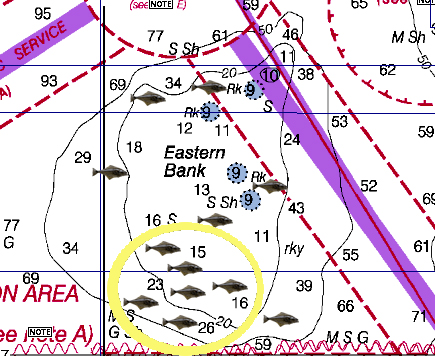
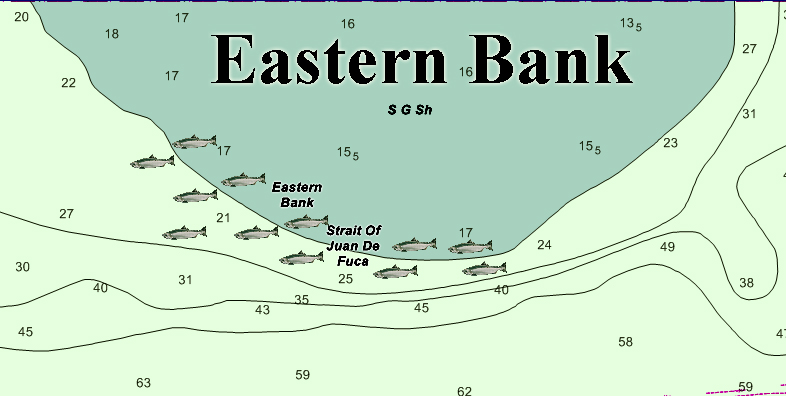
Eastern Bank Salmon Fishing Map

Here's where I target salmon on Eastern Bank on high and low tides. Best depths range from 90 to 130 feet. During an outgoing tide the bait will move into deeper water, so be aware of this and move west and be ready to drop your downrigger balls deeper if needed.

Here’s where I target salmon on Eastern Bank on high and low tides. Best depths range from 90 to 130 feet. During an outgoing tide the bait will move into deeper water, so be aware of this and move west and be ready to drop your downrigger balls deeper if needed.

Winter blackmouth fishing in Area 6 ends April 10th, giving everyone more than two weeks of prime fishing. Many of the area’s hatchery salmon have now grown past the 22-inch minimum size requirement and increased keep rates shown at Washington State Fish & Wildlife Creel Report.  << Click here to see the creel check. To say I fish lots would be a gross understatement. My boat, Salmon Seeker, sees lots of action on the water. At just 17 feet, with a Yamaha 70 horse four stroke it offers super affordable fishing. It takes just 3 to 6 gallons of gas for 90 percent of my salmon fishing adventures.

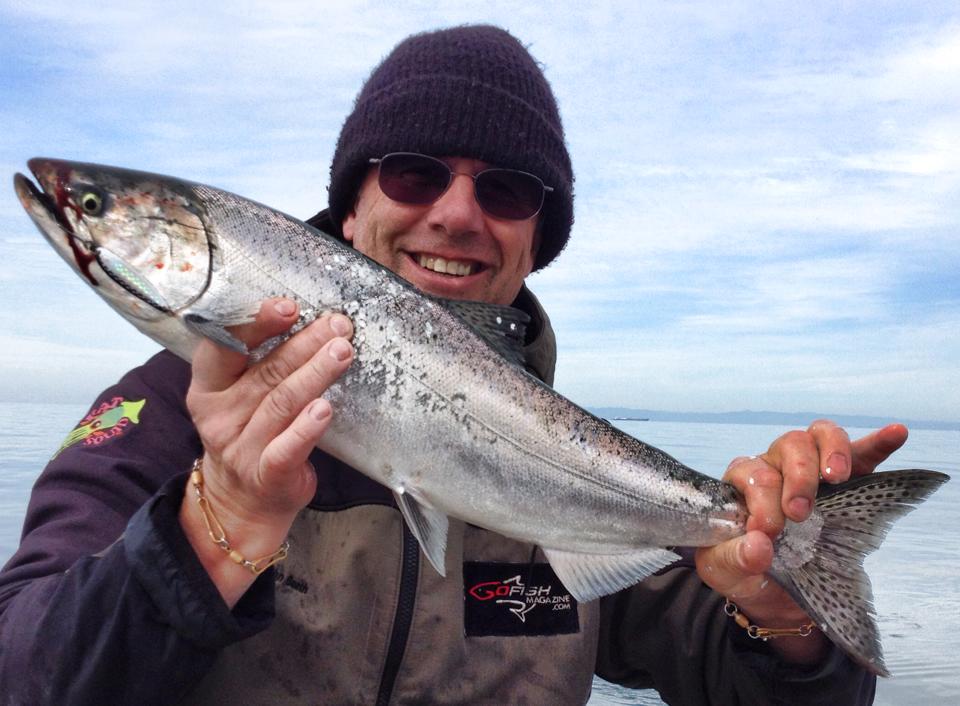
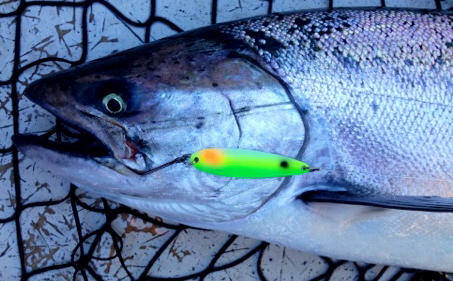
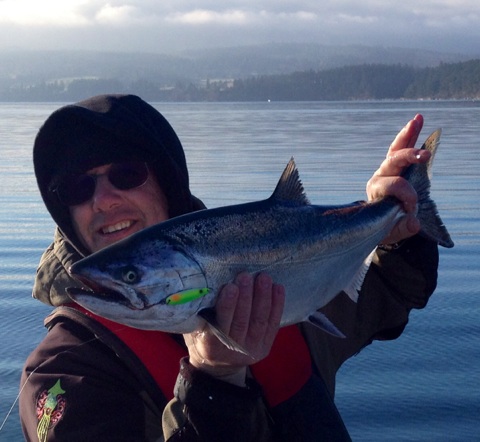
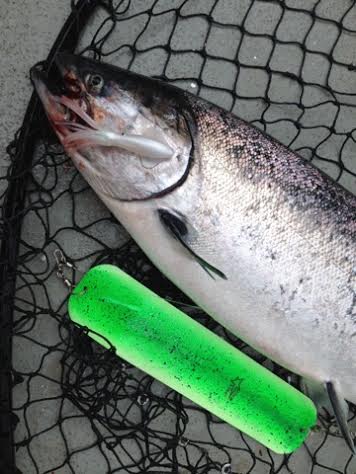
Lance Staub caught this nice blackmouth at Eastern Bank while trolling a Silver Horde #2 Kingfisher spoon.

Lance Staub caught this nice blackmouth at Eastern Bank while trolling a Silver Horde #2 Kingfisher spoon.

Yesterday, Friday March 13th I went salmon fishing on Eastern Bank for salmon. Eastern Bank sits in the middle of the Strait of Juan de Fuca, and offers anglers one of the best areas to catch salmon and halibut. The bank’s sandy bottom attracts massive schools of candlefish as well as herring and other bait fish. Several good salmon fishing reports from Eastern Bank combined with calm seas made this a good choice to try.

Upon arriving at the bank, we got our first line in the water, a chrome dodger with a Silver Horde #2 green spatterback Kingfisher spoon on a 40-inch leader. The first salmon hit before getting the second rod in the water. The area showed small schools of candlefish hovering on bottom as well as a few salmon working the bottom. I’ve fished Eastern Bank many times over the past few years and have always preferred fishing the southwest corner. This area attracts bait, salmon and halibut on incoming and outgoing tides. By 10:20 a.m. we had landed 10 salmon, of which only one was a hatchery keeper that measured 28 inches long. Right at 10:30, my rod that had my favorite old F4 Piscator flasher with a #2 cop car Kingfisher spoon jerked violently from the downrigger release. As soon as I grabbed the rod the fish thrashed its head, a clear indication a halibut grabbed my small spoon. No surprise there because my gear hovered within five feet off bottom, where candlefish and salmon were most active.

I lost a nice sized blackmouth and eventually landed this 25 inch hatchery blackmouth on Eastern Bank, while trolling an F4 Piscator flasher with a 40-inch leader and cop car colored #2 Kingfisher Silver Horde spoon.

I lost a nice sized blackmouth and eventually landed this 25 inch hatchery blackmouth on Eastern Bank, while trolling an F4 Piscator flasher with a 40-inch leader and cop car colored #2 Kingfisher Silver Horde spoon.

My first keeper hit a Silver Horde #2 cop car Kingfisher spoon trolled behind an F4 Piscator flasher on a 40-inch leader

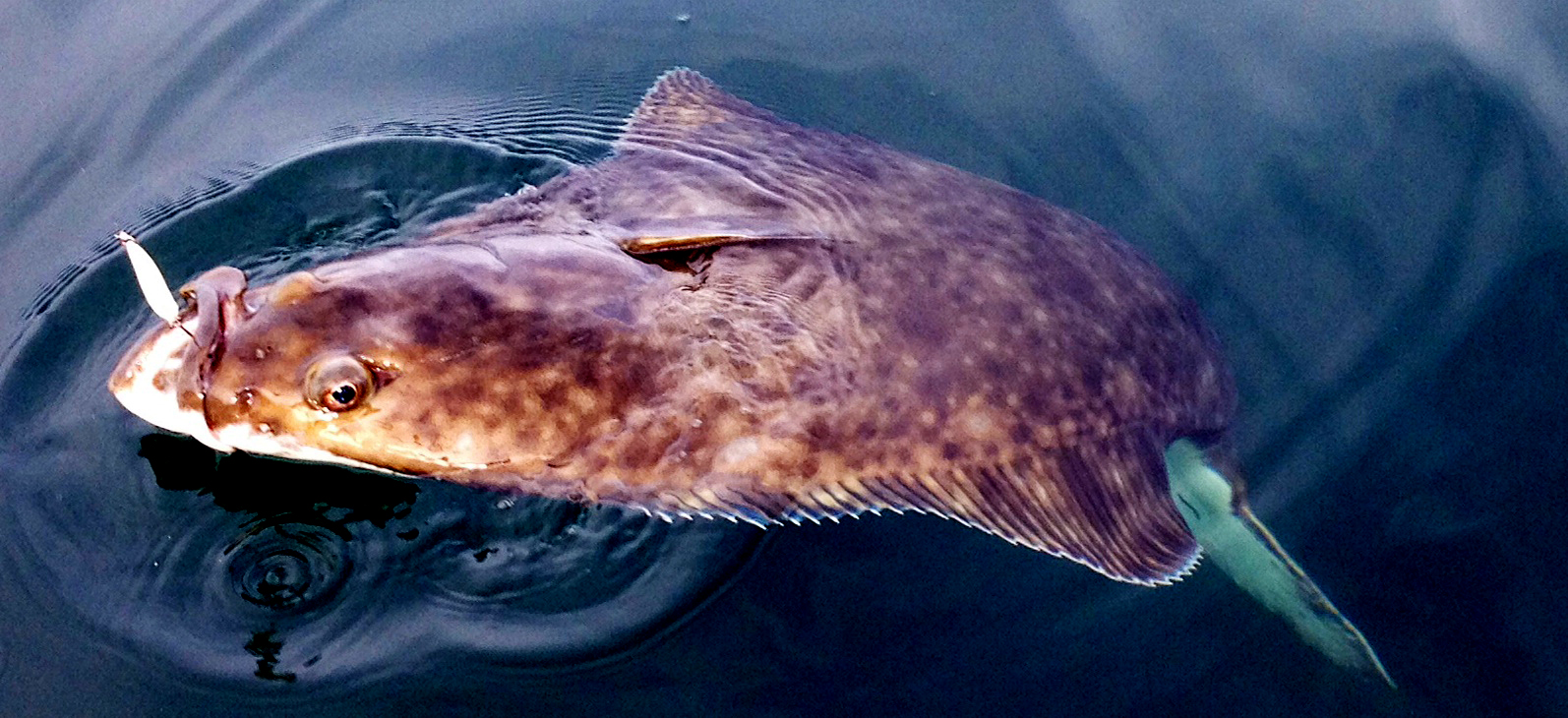
This nice sized 40-pound halibut grabbed a #2 cop car Kingfisher spoon.

This 40-pound halibut grabbed my Kingfisher spoon.

This 40-pound halibut grabbed my Kingfisher spoon.

Fighting halibut on salmon gear, especially “Canadian style” knuckle buster reels can be a vigorous challenge. As you can imagine, the halibut fought hard all the way to the top, then flattened out on the surface, where I tried to remove the barbless hook from it’s jaw.

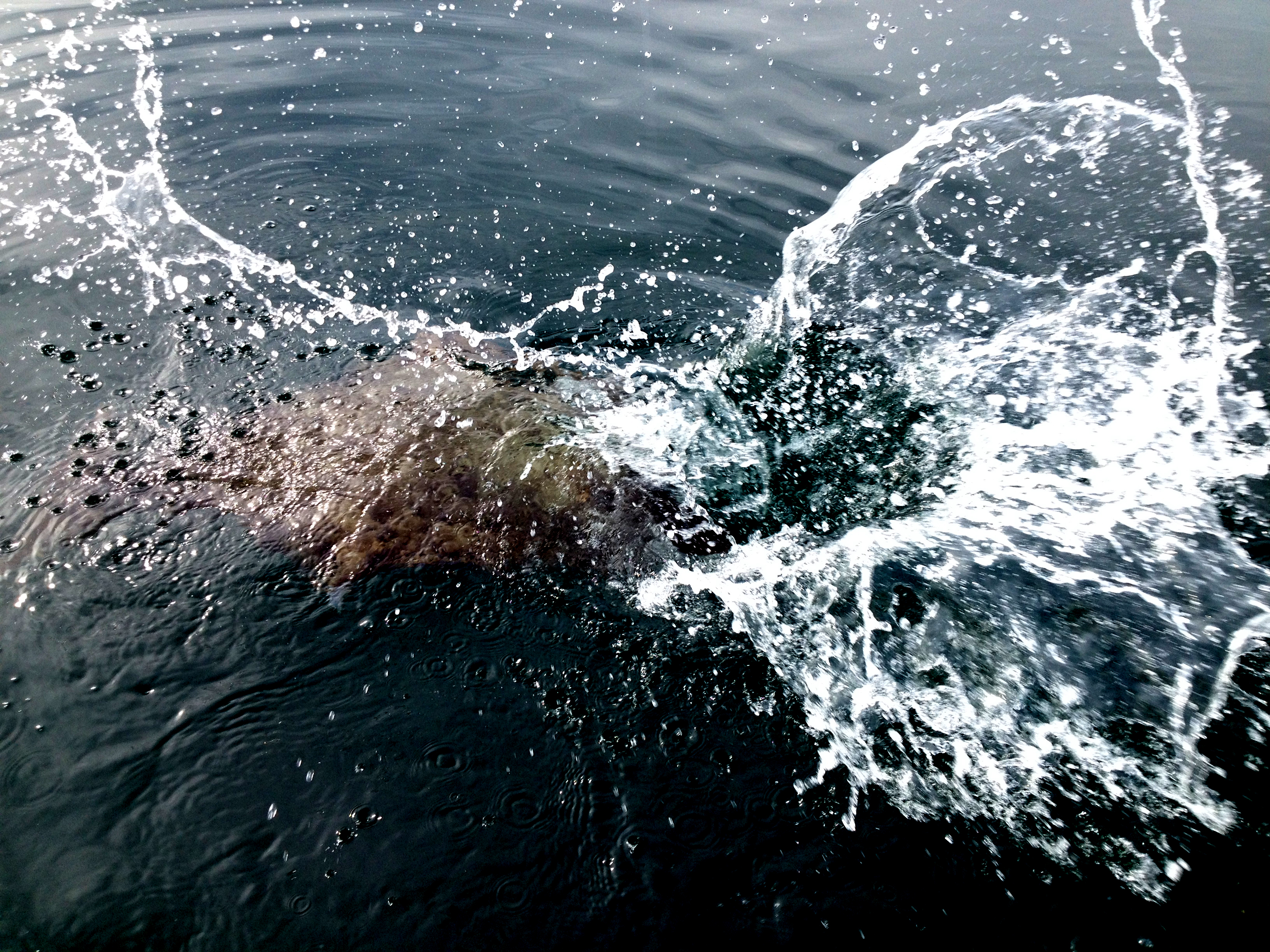
This halibut went crazy on the surface and gave me a saltwater shower.

The halibut came to the surface and gave me a saltwater splash before heading back to the bottom.

The halibut came to the surface and gave me a saltwater splash before heading back to the bottom.

The 40 pound halibut wanted no part of me reaching toward its mouth and gave me a saltwater shower as it headed back to the depths. After the halibut going to the bottom twice, it finally tired enough for me to grab its tail and remove the hook before sending it on its way. In past years I’ve caught halibut in Canada on my birthday, March 23rd, but never earlier than that date. This is a good sign for our upcoming halibut season.

Eastern Region (MA 6-10)

May 8-9
May 15-16
May 21-24
May 28-30

Here's where I target halibut on Eastern Bank.

Here’s where I target halibut on Eastern Bank.

Here’s where I target halibut on Eastern Bank during high and low tides.

All totaled, our Friday the 13th fishing trip to Eastern Bank provided us with 13 salmon to the boat, two of which had missing adipose fins and measured well over the 22-inch minimum size limit. We also lost a nice sized salmon and released the nice sized halibut.

When we first arrived at the bank the tidal flow was weak and incoming. Our best action happened during the incoming right through slack tide. When the tide turned and flowed out we stayed in the same area and continued to catch salmon, including one of the keepers. Whether fishing for salmon or halibut, Eastern Bank can provide excellent fishing on the southwest side.

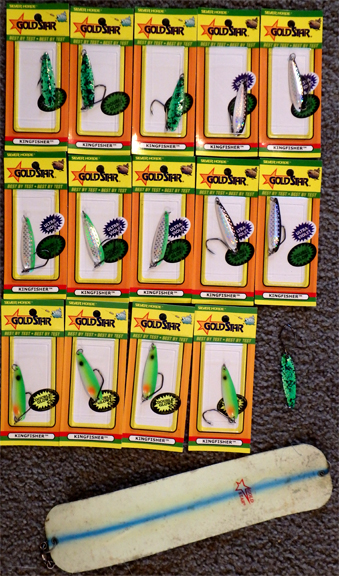
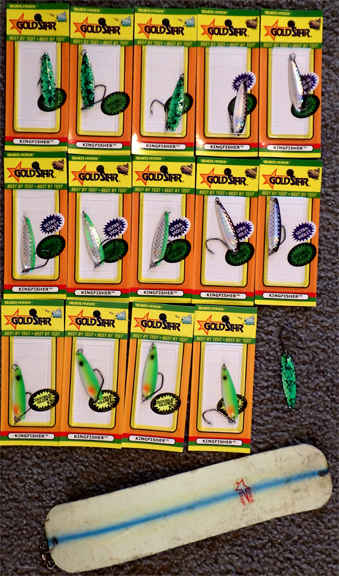
My favorite Kingfisher spoon is the green glow spatterback. The halibut went for the cop car colored spoon. All of these spoons work great, but the greens work best for salmon on Eastern Bank.

My favorite Kingfisher spoon is the green glow spatterback. The halibut went for the cop car colored spoon. All of these spoons work great, but the greens work best for salmon on Eastern Bank.

Posted in Salmon Fishing, Salmon Fishing Maps, Salmon Fishing Tackle, Salmon Fishing Tips & Tricks, Washington Salmon Fishing | Tagged , , , , , , , , | Leave a comment

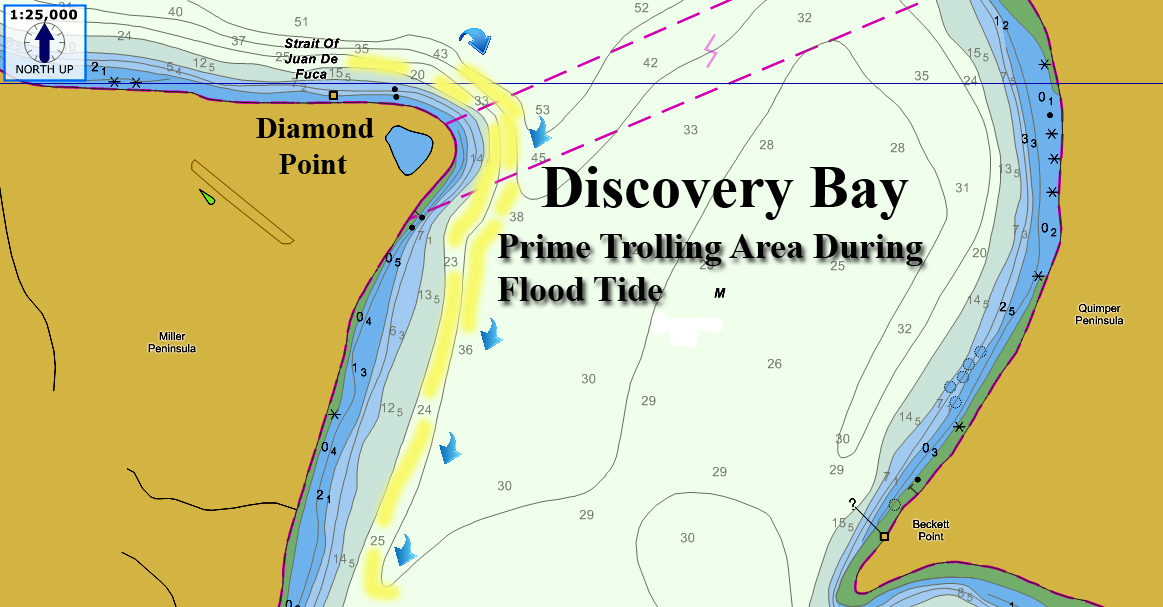
How to Fish Diamond Point Inside Discovery Bay

Discovery Bay’s Bounty of Blackmouth at Diamond Point  “Click to Enlarge Map”

Diamond Point

Discovery Bay Salmon Fishing Map

Many of the hardcore blackmouth anglers don’t bother fishing flood tides at Protection Island or inside Discovery Bay. They say the Ebb tide produces best, which I won’t argue. However, since the area has an abundance of bait, that moves with the tide, it only makes sense to find where bait and blackmouth can be found and enticed into biting.

Diamond Point Salmon Fishing

The Point revealed salmon and bait and continued to show blackmouth feeding on bottom as we trolled farther inside Discovery Bay.

This week I fished five days in a row, prospecting Hein Bank, Eastern Bank, Protection Island and Diamond Point, inside Discovery Bay. The two banks failed to reveal any bait or blackmouth, while Protection Island did have bait and some nice salmon during the ebb tide. Thursday morning when I launched at John Wayne Marina, the plan was to look for bait at Protection Island and fish if the sounder revealed bait and or blackmouth. Nothing showed on the screen, prompting me to head toward Diamond Point. My fishfinder revealed bait and blackmouth within seconds. Both 15 pound downrigger balls soon skimmed to within a few feet off bottom, with F4 Piscator flashers and size #2 Kingfisher spoons tied to 40 inch leaders. Trolling with the tide and staying between 140 to 180 feet did the trick. On the third pass trolling south with the tide, the starboard side downrigger started dragging the bottom followed by a hard hit that released from the clip.

KingFisher Spoons Catch Salmon at Discovery Bay

Discovery Bay Blackmouth fishing with Silver Horde F4 Piscator flashers and size #2 Kingfisher spoons.

A few minutes after landing the 29 inch deep shouldered, adipose clipped blackmouth, we began trolling along the same depth contour. Again, as soon as the ball scraped bottom another fish hit, released from the ‘rigger but shook off the hook.

This fish also had an embedded tag in its head, which will eventually tell me where it came from. Ryan the fish checker took the head and will turn it into the lab, along with scale samples. Within two months a notification should arrive by mail with details of which hatchery this fish came from. When I cleaned the fish it had four inch candlefish in its belly, which explains why the salmon are so close to bottom — they love picking at the bottom where candlefish hide. During candlefish spawning times, Chinook salmon often have scraped up gill plates. This fish also had immature egg skeins.

Discovery Bay Trolling

Trolling to the east into the steep bottom revealed more blackmouth feeding on the bottom.

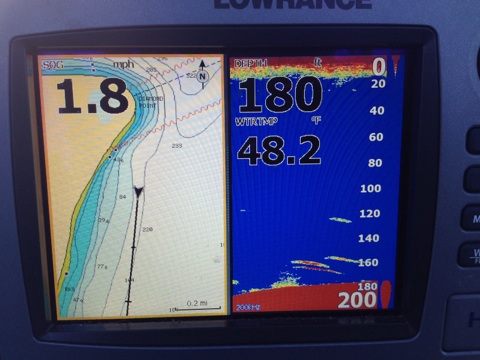
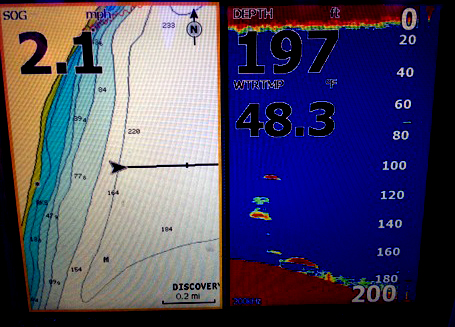
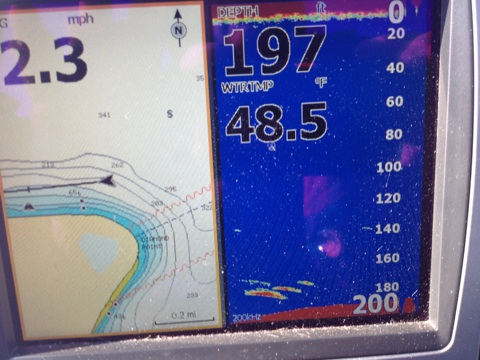
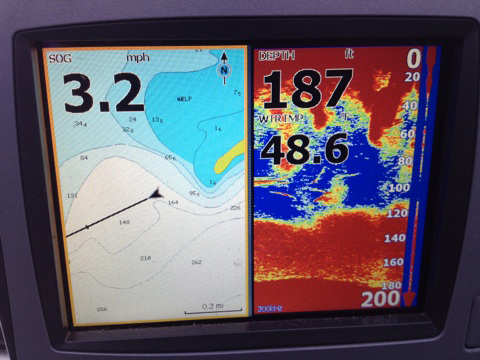
As the flood tide progressed my troll pattern took me farther inside Discovery Bay, just past the bluff which sits south of the homes at Diamond Point. We also noticed lots of fish on the edges, where the bottom drops off the contour line. Take a look at these images of my fishfinder as we trolled the area.

After the tide turned we began trolling back toward Rocky Point and continued to mark salmon feeding on bottom.

IMG_3569Jiggers and moochers also catch fish in this area. My first time fishing this spot was with a Dungeness Stinger. The trick, like most areas, revolves around locating bait or those BIG, beautiful salmon marks near bottom.

Good luck,

John

Discovery Bay Blackmouth Fishing

Here’s the fat 29 inch blackmouth that did not get away Thursday morning during flood tide inside Discovery Bay, at Diamond Point

Posted in Salmon Fishing Maps, Salmon Fishing Tips & Tricks, Washington Salmon Fishing | Tagged , , , , , , , | 1 Comment

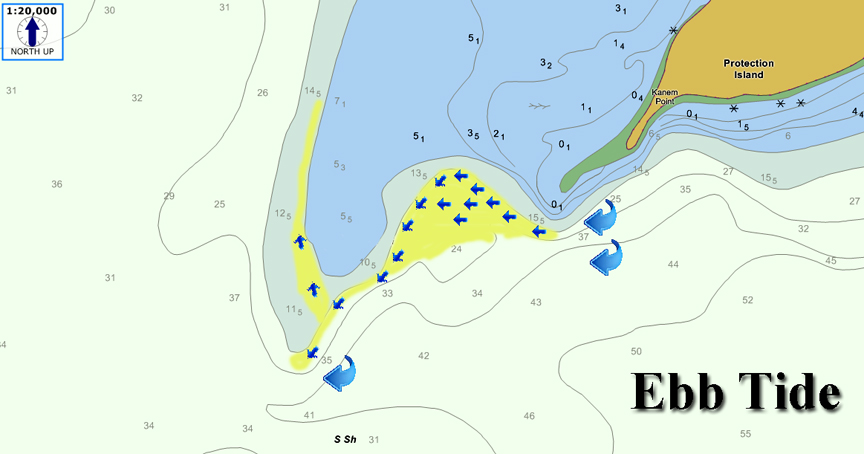
Protection Island Salmon Fishing Map For Ebb Tide

How to Fish Protection Island During An Outgoing Tide

Ebb Tide Salmon Fishing at Protection Island

How to salmon fish at Protection Island during outgoing tide

Ask any regular at Protection Island and they will tell you an outgoing (ebb) tide is best for catching blackmouth salmon. Some of the anglers I know say the ebb tide produces about 3 to 1 over the incoming (flood) tide.  The chart above shows the current direction as it flows across the shallow sandbar extending out from Kanem Point. As the water moves across the bar it creates a strong current that forces bait into the “Horseshoe” like area. As the current increases more bait appears and so do the blackmouth salmon.

How to fish Protection Island for salmon

Massive schools of bait and feeding blackmouth salmon at Protection Island

Some of the anglers stay close to the contour line while others, including me, venture into the middle of the horseshoe. My trolling pattern varies according to currents, trolling with and against in search of bait and salmon. Take a look at these images taken last week. When trolling close to the contour lines my downrigger balls typically stay within about 10 feet off bottom. As soon as my troll pattern takes me into the center of the horseshoe I closely watch where the bait is concentrated and where the salmon appear on my fish finder. My most productive depths here have been 120 and 140 feet, even though the depth ranged from 160 to over 200 feet in some areas.

Don’t be afraid to venture into the shallows either. Blackmouth will follow bait into the shallows along the left side of the horseshoe. But remember to watch and work your downriggers as you venture into the shallow area. The chart shows the troll pattern that ranges from 50 to 75 feet. The dark blue area is just 35 feet but does produce fish. Luckily the entire area has a sandy, super forgiving bottom that won’t snag your downrigger balls easily. When in the shallows keep your balls about five feet off bottom. I’ve also seen anglers hook up while dragging their balls. Herring seems to work best in the shallows, but artificial lures work too.

mini FAT Squid for blackmouth

How to fish winter blackmouth Chinook salmon at Protection Island

Best lures include mini FAT Squids#2 Kingfisher spoons, Coho Killers, & needlefish hootchies. Best colors include glow, uv, white and green combinations. Leader lengths vary, depending on the lure. A 50 to 60-pound 24 inch leader works great with a mini FAT Squid. Try a 30 pound  36 inch fluorocarbon leader with small spoons. Needlefish hootchies work well with 30 to 40 pound fluorocarbon 28 to 36 inch leaders. Some of the anglers I know cut an inch off the end of the needlefish to match the bait size. If you choose bait, 2/0 or 3/0 single or double hook leaders tied on 40 to 48 inch fluorocarbon 20 pound leaders work well.

Flashers and squid work great for winter blackmouth

Winter blackmouth salmon at Protection Island

F4 Piscator flashers provide awesome salmon catching action on my squids, hootchies and spoons. Flashers rotate and cause these lures to whip side to side like a fleeing baitfish. Since spoons have their own unique wobble, twitch or flutter they can be fished on longer leaders without relying on the flasher to create the fish attracting action needed to trick salmon into biting. You can use flashers with bait as long as you use a longer leader. However, I much prefer using Goldstar dodgers. Dodgers, when trolled slow move side to side giving the herring a little side to side kick that salmon like. Either whole or cut plug herring will work, but remember to use the right size herring for the predominate bait in the area. Right now the blackmouth are feeding on small two to three inch baits.

Productive trolling speeds will vary depending on your direction of troll and the direction of current. The most important factor is the angle of your downrigger lines. No angle means your flashers won’t rotate and therefore won’t give your squids or hootchies action. To much angle and your gear will either be to far off bottom, away from feeding salmon or simply have to much action for the salmon to catch. If you are using only bait, you can troll as slow as you want, as long as the bait still spins. That said, I like to troll at least 1.8 mph to 3.5 mph. Again, don’t focus so much on speed over ground, pay attention to your line angle and whether your lures have action.

Good luck, hope to see you on the water.

John

Posted in How to choose lure colors, Salmon Fishing, Salmon Fishing Maps, Salmon Fishing Tackle, Salmon Fishing Tips & Tricks, Washington Salmon Fishing | Tagged , | 1 Comment

Kingfisher Spoon Size 2 Field Test at Protection Island

Saturday six blackmouth salmon hit our artificial baits. Some of the fish were shakers, others were nice “keeper” sized immature Chinook salmon that measured over the legal minimum of 22 inches. Two nice sized fish hit, striped line and eventually got off our barbless hooks. We kept two fish and brought them back to John Wayne Marina’s cleaning station. First order of business, open the stomach and see what the fish were eating. Not surprisingly, their stomachs were filled with two to three inch little “poggie” like baitfish, tiny shrimp and baby squids.

Small Salmon Spoons

Sized 2 Kingfisher Silver Horde, Gold Star Salmon Hooks Match The Hatch When Salmon Feed On Small Baits.

After visiting Silver Horde in Lynnwood on Monday, I told Kelly Morrison about these small baits.  Morrison is the son of the founders and said, “I have a lure for you to try.” He then showed me the small, sized 2 Kingfisher spoons which perfectly matched the size of baits throughout the Protection Island area. He picked out several colors for me to try, based on popularity and what I typically buy throughout the year. Of course, my favorite Silver Horde color is the Glow/Green Spatterback. I have a bunch of F4 Piscators in the same color as well as downrigger rudders, Coho Killers, hoochies etc.

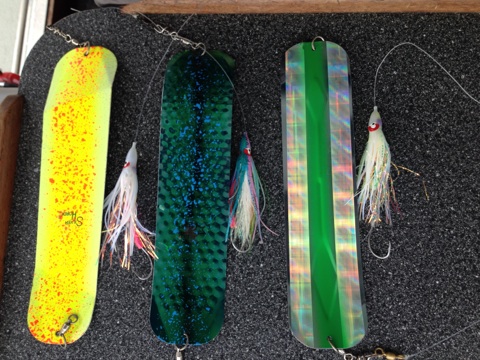
The F4 Piscator flasher on the left is over 20 years old and one of my favorites. This flasher once helped me win a salmon derby and place second in another. All totaled that single flasher made me over $3,000 in prize winnings. When I moved two years ago I found it and resurrected it and put it back in service. Today I paired it with the small Kingfisher #2 spoon pictured. Since this spoon is small and offers excellent wobbling action, I used a length of 30 pound fluorocarbon that equaled 3 1/2 lengths of the flasher. When using hoochies or heavier squids, like my mini FAT Squids, a shorter heavier leader works best. But since this spoon already has great action, the flasher is used as an attractor instead of “action creator.”

Fishing for Puget Sound Salmon With Spoons

This winter blackmouth Chinook salmon went for Silver Horde size 2 Kingfisher spoon behind and F4 Piscator flasher

Trolling the setup within ten feet of the bottom worked with a few minutes, attracting a 26 inch wild fish. A quick picture and twist of the “River Style” hook sent the fish away unharmed. This style of hook has become popular and seems to hold fish better than standard “siwash style” hooks when fishing spoons.

F4 Piscator Flashers

F4 Piscator Salmon Flashers Catch More Salmon

By day’s end we hooked three fish on this spoon, landed two and lost one. Another advantage of this spoon is speed or lack thereof. Like bait, you can slow down or speed up and still catch fish. It also paired nicely with my mini FAT Squid. Sometimes when fishing two rods I fish them both just off bottom. Today I had to separate my two lines because my downrigger balls were not matched in weight today.  Unmatched weights can cause tangles, so the spoon, with the heavier weight stayed closer to bottom. On Wednesday both balls will match and both lines will be closer together without fear of tangling.

Adding scent to the spoon or your hootchie, squid or other lure will increase your odds. Today I fished the spoon “naked” without scent as well as with scent. With scent attracted twice the bites, but it still got bit without scent, a good sign for any lure. My Super Scent paste sticks well to lures and will continue to be my favorite choice. If you can’t find Super Scent choose a scent that is sticky to enable it to stick on the hook and inner side of the spoon. Reapply scent every time you deploy the spoon.

Length behind the ball. Most days I fish close to the ball, about 12 feet. Today, with the flasher/spoon, I choose to send the gear back 50 to 70-feet for two reasons. First, with lighter leaders distance equals “forgiveness” and insurance that a bigger fish won’t break your leader. Remember, when using monofilament it stretches up to 30 percent. Secondly, it offers a delayed offering. Fish like to follow flashers and more often than not refuse an offering. Having a set back offering can get the non biters to commit.

Thursday I’ll post a new Protection Island Fishing Map, so stay tuned.

Good luck and good fishing.

John

Posted in Uncategorized | 1 Comment

Silver Horde — Gold Star Downrigger Rudders, F4 Piscator Flashers & Kingfisher Spoons

Yesterday I visited Kelly at Silver Horde. We’ve known each other for more than 30 years and during that time visits to their Lynnwood Washington store has always brought a smile to my face. My reason for visiting was simple — replace some items not available locally. Specifically, downrigger rudders. Over the years these rudders have accompanied my downrigger balls and helped attract more fish. Anglers always ask me, what is that thing on your downrigger ball? My answer, it’s a fish magnet!

Silver Horde Downrigger Rudder

Special LFS downrigger rudder custom color

LFS (Lumi Fishing Supply) in Bellingham Washington custom designed the color of this awesome looking Silver Horde downrigger rudder. They will be available at the LFS booth at the Seattle Boat Show. Today I tried one and it worked great!

Notice the heavy mono line at the end. I use 500 pound mono with glow tubing over the mono and crimp a clip for the rudder side and a Scotty downrigger clip for the fishing line side. This works great for me.

Silver Horde salmon flashers work best

These F4 Piscator flashers work great for me. So great I had to buy enough for guiding in Alaska this summer.

How much do I love these F4 Piscator flashers? Judging by yesterday’s purchase, I love them lots! These flashers will help attract salmon to my lures and baits while fishing locally and will no doubt help my Whaler’s Cove Lodge guests in Alaska catch more fish.

After telling Kelly about the clouds of bait around Protection Island and the small baits the blackmouth have been eating, he showed me their brand new #2 size Kingfisher spoon. The spoon is the same size as the little baits the fish are feeding on, so I left the store stocked with enough spoons to give them a try. Within a few minutes of lowering the spoon near bottom, wham, fish on the port side. Throughout the day we hooked three blackmouth on the spoons, fished behind an F4 glow Piscator flasher with a 36 inch 30 pound leader. When using spoons that their own action, I typically use a longer leader than would be customary on one of my squids. And since this is a small spoon 30 pound leader enabled great action on the spoon. Heavier leader would likely rob some of the action from the spoon.

Fishing for Puget Sound Salmon With Spoons

This winter blackmouth Chinook salmon went for Silver Horde size 2 Kingfisher spoon behind and F4 Piscator flasher

Posted in Uncategorized | 1 Comment

Protection Island Winter Blackmouth Fishing Map & Techniques

Winter blackmouth fishing can be a challenge, especially if you don’t know the area. After moving to Sequim two years ago I began the fun task of learning new waters, specifically the Protection Island area. This great area is close to John Wayne Marina and offers some protection from wind.

Protection Island

The chart above shows the prime areas to fish Protection Island. The finger that extends from the SW side of the island holds bait which in turn attracts hungry blackmouth. A few anglers jig the area on an outgoing tide. When jigging start at the inside of the finger, in shallow water, which drops into the deep. During a perfect tide the drift will carry your boat across the prime zone marked in yellow.

Winter Blackmouth Fishing at Protection Island

Trolling mini FAT Squids at Protection Island works great.

Most anglers, including me, use downriggers to fish this area. On either tide troll the outside of the finger, marked in yellow, turn and troll back to the end of the finger. As you can see by the the chart, the prime catching zone sits at the end of the finger. Sometimes, however, trolling the inside of the finger will also produce fish. When fishing this zone keep baits and lures within 10 feet of bottom for best results. The finger area of Protection Island has a shallow area and deep area. While some fish are caught in the shallow area by jiggers and trollers, I have the best results while staying on the deep side of the finger. One of the tricks I use to keep me in prime water and on course is my GPS “snorkel.” The snorkel projects your boat’s direction of travel. I set my snorkel to one mile, giving me a nice straight line to enable me to stay on course. Some GPS units also have a time function setting for the snorkel. By choosing this function your snorkel will lengthen or shorten based on your boat’s speed. Either function works great and keeps you on track, and in the prime fishing zone.

During strong incoming tides, if the bite fails to materialize on the finger I choose a different, unconventional troll pattern. Currents will often force bait out of the prime outer finger zone, toward Diamond Point. When this happens I begin trolling with the current, into the mid channel region marked in yellow. And unlike the previous area, where it is crucial to be close to bottom, my downriggers stay in the 90 to 140 foot zone no matter what the depth reads on my sounder. As the currents push the bait into the center channel, between Protection Island and the Peninsula, blackmouth follow and will bite your offerings. You’ll likely troll faster here, which is just fine. As you can imagine, the bite will be aggressive because of your boat’s speed combined with the salmon’s aggressive nature of attacking baitfish from behind. I’ve taken several nice blackmouth without any other anglers within sight. Also, during an outgoing tide this tactic works when fishing Diamond Point. Just reverse the troll and head toward the outer finger.

Tackle & Tips

Flashers & mini FAT Squids catch winter blackmouth salmon

mini FAT Squids combined with Silver Horde F4 Piscators works great at Protection Island.

Most of the fish taken on my boat, “Salmon Seeker” are taken on a 5-inch mini FAT Squid trolled behind a chrome dodger or my favorite flasher, the Silver Horde F4 Piscator flasher. Several colors work great, but my favorite is the glow/green spatterback. While fishing in Alaska at Whaler’s Cove Lodge last summer, these flashers out-fished ALL other flashers. Trust me on this, it was not even close. These flashers CATCH MORE CHINOOK SALMON — PERIOD! Silver Horde’s Rudder Flasher also dramatically increased my success rate. For four weeks I had just one rudder on my charter boat, until Silver Horde shipped me additional rudders. During that time, the downrigger that had the rudder caught 100 percent of the Chinook salmon.

Glow and White mini FAT Squids and hootchies work best while fishing Protection Island. When fishing deep these colors get the most bites. During sunny bright days UV colors work exceptionally well.

Small whole herring baits also work well, but overall, artificial lures caught more fish on my boat last season.

Flashers & Hootchies work great for Protection Island salmon

The best Salmon flashers in the world, Silver Horde’s F4 Piscators

In addition to mini FAT Squids, hootchies combined with a flashy twinkle skirt fly also worked extremely well when targeting Chinook salmon. A small strip of salted herring pinned to the top hook adds the perfect amount of scent to the combination.

Leader lengths: When fishing mini FAT Squids a 50 to 80-pound 24 inch leader works best. Stiff, heavy leaders work well because they make the lure snap back and forth like a fleeing squid and prevent broken leaders from aggressive bites and sharp teeth. Hootchie leaders can be longer and made of smaller diameter leaders, but not less than 30-pounds. I’m also fond of using high quality fluorocarbon leaders, which provide additional stiffness while rendering the leader invisible.

DSCN1913Best Trolling Speeds: Winter blackmouth salmon are immature salmon that move fast. Unlike mature king salmon, which often prefer slower moving baits and lures, blackmouth prefer faster moving baits. My speed over ground varies between 1.8 and 2.8 mph and sometimes hits 3 mph, depending on conditions. The key to speed is the action of your lure behind the flasher or dodger. If you are trolling slow shorten the leader behind the flasher or dodger. Also note, dodgers work great at Protection Island and will allow for slower trolling. When combining lures with whole or cut herring baits, dodgers impart action while allowing for slower speeds. Again, adjust speed and leader lengths to give maximum action. Typically I’ll use a 36 to 48-inch leader when using whole herring behind flashers and dodgers. Using both bait and lure on both sides of the boat allows me to combine techniques. Typically I’ll put a whole herring four feet behind the dodger at depth on the downrigger and an F4 glow/green spatterback flasher with a mini FAT Squid on a 24 inch leader on the other downrigger. Distance behind your downrigger ball also makes a difference. If you increase the distance behind the ball it will dampen the action because it will increase the diameter of the flasher’s roll. Shortening the distance behind the downrigger ball with decrease the flasher’s roll and increase the lure’s action. I prefer a distance of 12 to 20-feet behind the ball, depending on several factors that include tidal flows, boat speed, baits, lures and leader lengths. It takes lots of experimentation with your boat to determine the best leader lengths and distances behind the ball. Keep good notes of what works best for you.

Blackmouth fishing Protection Island

mini FAT Squids catch fish at Protection Island

Best Times To Fish Protection Island: I like strong tides, either outgoing or incoming. Heavy, fast moving tides concentrate bait which in turn makes it much easier to find blackmouth. During minimal tides the fish stay scattered, forcing anglers to search for schools of bait. During small tidal flows it’s best to stay close to the finger or outer edge of the finger because that is where the bait will likely be found. Again, when the tidal flows are strong don’t be afraid to explore the middle channel marked in yellow. And during any tidal flow, don’t forget to check the shallow bar that creates the Protection Island finger, as the bait and blackmouth will go shallow. When this happens keep the baits and lures close to bottom.

mini FAT Squids catch Chinook salmon

http://www.fatsquids.com is where to buy mini FAT Squids

If you are looking for mini FAT Squids check out FATSquids.com or Halibut.net

Good luck this winter.

For more information about Silver Horde’s great products, please visit their site at SilverHorde.com


rudderflasher

F4 Piscator Flashers

Best salmon fishing flashers, the Silver Horde F4 Piscator flasher

Posted in Salmon Fishing Maps, Salmon Fishing Tackle, Salmon Fishing Tips & Tricks, Washington Salmon Fishing | Tagged , , , , , , , | 1 Comment

Big Chinook Salmon Caught On The JIL Today!

Image

Today my first guests arrived, Ed and Glenn Mendell from the Bay Area of California. After catching limits of halibut we moved to Hood Bay, where a few big kings have been caught recently. Within a few minutes of arriving the starboard downrigger rod erupted with several violent shakes quickly followed by it releasing from the tight downrigger clip. Seconds later the line went limp and the hooks disappeared. New strategy, heavier leaders and bigger baits. Half an hour later the port rod popped off the rigger and the tight drag spun off the reel. Glenn tried to free the rod from the rod holder but the fish’s run prevented him from getting the rod out and in his hands. This time the fish just came un-bottoned, leaving a pearl white Kingfisher spoon dangling in the water. Hit three also bounced off the downrigger and left no hooks. Uhmm? Must be big fish or salmon sharks in the area.

This time I switched to 40 pound leader with two 6/0 hooks on a five foot leader and tied it to an Silver Horde F4 Piscator spatterback green/glow flasher. Five minutes later the reel spun off the reel, the rod buckled toward the water, fish on! Glenn grabbed the rod and expertly fought the fish to the back of the boat and my landing net.

Image

Can’t wait for tomorrow’s fishing action. Wish us luck…

Tight lines,

John


Posted in Alaska Salmon Fishing, Salmon Fishing, Salmon Fishing Maps, Whaler's Cove Lodge Salmon Fishing | Tagged , , , , | Leave a comment

Chaik Bay Chinook Salmon

ImageYesterday I joined new Whaler’s Cove Lodge Captains Bob Sauerwein and Malcolm Quentin on a test fishing trip to Chaik Bay. This scenic bay has dozens of underwater spires, rocks and reefs. Venturing inside Chaik Bay requires local knowledge and a keen eye trained at the depth sounder while slowly navigating the waters.

Once past the obstacles we set up our troll in a shallow area within 50 yards of the shoreline. Baitfish jumped all around us, a sure sign of hungry salmon. Captain Bob deployed his cut-plug herring while I deployed a whole herring. Captain Malcolm took the steering duties. Half an hour into the troll Captain Bob decided to check his bait, reeled up the downrigger and then began to hand line his herring back to the boat. Luckily my eyes caught the action, as a 20 pound Chinook came to the surface and inhaled the cut-plug.

ImageCaptain Bob set the hook with his hand, then passed the rod to Captain Malcolm to give him a chance to play the Chinook on light line. The fish made four strong runs before calming down enough to release the hooks and let it go.

ImageTwenty minutes later another Chinook slammed my F4 Piscatator Glow/Green Spatterback flasher and whole herring. We released that fish too, and enjoyed the scenery and uniqueness of the quiet bay. Unlike many fisheries, the Chinook here range from the surface to the bottom, a window of 60 feet.

Can’t wait to see what adventures today will bring at Whaler’s Cove Lodge. Today the lodge opens with the first guests arriving on Ward Air Seaplanes.

Image

Tight Lines,
John

Posted in Alaska Salmon Fishing, Salmon Fishing, Salmon Fishing Maps, Whaler's Cove Lodge Salmon Fishing | Tagged , , , , | Leave a comment

Eagle Swimming in Saltwater

John L. Beath's avatarSquidPro Tackle's Halibut Fishing Chronicles
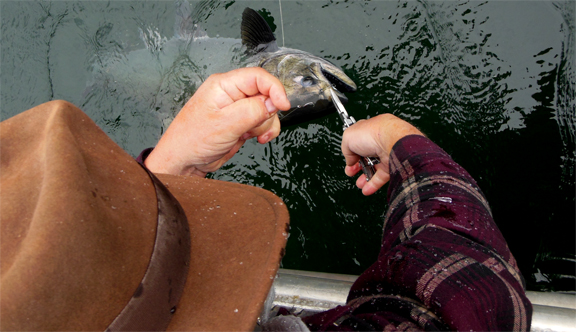
Two days ago I watched two eagles lock talons from about 300 feet above the water. Were they mating or fighting? I don’t know the answer to that question. As I watched in awe they plummeted to the water and failed to part before splashing into the water. One eagle was able to hop atop the other eagle and take flight, leaving the second eagle flopping in the water. The first eagle then continued to swoop toward the eagle in the water with talons extended, going for the other eagle’s head. The eagle in the water went on it’s back and tried to defend itself.

After seeing this I was able to position my boat close enough to prevent the attacks. The eagle then began the long swim to shore. I then began recording video using my iPhone 4s. Not shown in the video is the seal that decided it…

View original post 47 more words

Posted in Uncategorized | Leave a comment