Steelhead Fishing on Hoh River With Guide Pat Neal

YouTube Image.jpgApril is a great time to experience some of the best steelhead fishing in the world, on the Olympic Peninsula’s Hoh River. Yesterday, April 9th, friend Robert and I joined famed steelhead guide, Pat Neal for a 10 mile float on the lower Hoh River.

Our float began at the Cottonwood Campground and wound 10 miles downriver to a private land pullout that costs $5 upon retrieving your drift boat.

During our float trip, Pat Neal entertained us with stories of Mick Dodge, local politics and of course plenty of fishing stories. Pat has been a full time guide since the mid 1980s and also writes for the Peninsula Daily News, as a “Wilderness Gossip Columnist.” I’d heard stories of Pat for years and now I know why. He is super humble with his expert skills, claiming not to be the best guide, just friendliest. His intimate knowledge of the river, wildlife and local politics make him a wealth of entertaining knowledge while he expertly rows the river. His fishing skills give his customers an edge to catch the targeted species, BIG fish.

OLYMPUS DIGITAL CAMERA

Pat Neal and his favorite Yakima Bait Plugs

Pat likes to pull plugs because he says they catch the biggest fish. Before launching down river, he tied on pink colored plugs, put them in the river and made sure they wiggled just so. While stroking with the oars he regaled us with stories of local wildlife, personal reflections and inside stories of his friend, Mick Dodge.

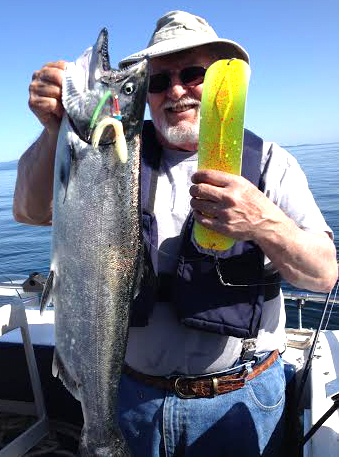
The first few hours resulted in just one hit and miss. Two thirds of the way down river my rod doubled over with a chrome bright 12 pound hen that we quickly released. An hour later, while trolling the same pink plug, a massive chrome bright hen hit the plug and launched itself clear out of the water. A quick measurement put the fish at 18 to 20 pounds, according to Neal. My previous best was a chromer from the Cowlitz. Upon close inspection of the images and video, I’d put this bright steelhead at 17 to 18 pounds, a trophy by any measure.

Anyone looking for trophy steelhead should plan a trip to the Olympic Peninsula in April. If you want the best edge at catching a trophy fish, give Pat Neal a call. With luck he will fit you into his busy guide schedule. For more information contact him via his website.


Posted in Uncategorized | 1 Comment

Honesty & “Encounters” Will Likely Close Area 6 Early

000020Last Friday Area six salmon fishing rules changed from two fin clipped 22-inch or bigger Chinook to just one fish. When the WDFW sent out their press release, they noted that anglers had already reached 71% of allowable “encounters.”
In a nutshell, every time an angler has an encounter with a Chinook, either releasing a wild Chinook or undersized Chinook it counts toward the 2,586 encounters by sports anglers. The state relies heavily on fish counts at local marinas and boat launches. So, every time someone “encounters” a fish checker and brags about their fishing prowess, which may or may not be accurate, each fish verbalized to the checker counts against our Winter Blackmouth season. Honesty then, can hurt or help our Chinook seasons depending on the angler. While not advocating dishonesty about “encounters” I would suggest anglers be more wise while fishing and while at dock, speaking to fish checkers. First off, don’t use teeny, tiny lures — they catch more sub-legal fish. Target bigger fish with bigger lures. You won’t get as much action, but that’s the point. When you get a bite it will likely be a keeper sized fish over 22-inches. Lures should be at least 4.5 to 5 inches in length. Fast trolled plugs also help to avoid short salmon.

When speaking with the fish checkers use common sense and be honest about your catch.

WDFW FISHING RULE CHANGE 
Washington Department of Fish and Wildlife
600 Capitol Way North, Olympia, WA 98501-1091
http://wdfw.wa.gov

January 28, 2016

Anglers limited to 1 Chinook per day in Marine Area 6

Action: The daily catch limit for Chinook salmon in Marine Area 6 (East Juan de Fuca Strait) will be reduced to 1 fish, with a 2 salmon limit. All wild Chinook salmon must be released.

Effective Date: Feb. 5 through April 10, 2016.

Species affected: Chinook salmon.

Location: Marine Area 6 within Puget Sound.

Reason for action: Before the salmon fishing season started, WDFW and tribal co-managers agreed to a limited number (2,586) of Chinook encounters – retaining or releasing fish – anglers are allowed in Marine Area 6. Preliminary estimates indicate that anglers have reached 71 percent of those encounters. The fishery is being modified to control impacts on stocks of concern.

Other information: WDFW will continue to monitor and evaluate the fishery in order to help maximize fishing opportunity is available for Marine Area 6. Anglers are reminded that they must continue to release all wild chinook.

Information contact: Ryan Lothrop, (360) 902-2808.

Posted in Uncategorized | 1 Comment

Salmon Tackle Special

We are offering a super special deal, only available for four days or until 10 specials have been sold. Check it out and purchase here.

OLYMPUS DIGITAL CAMERA

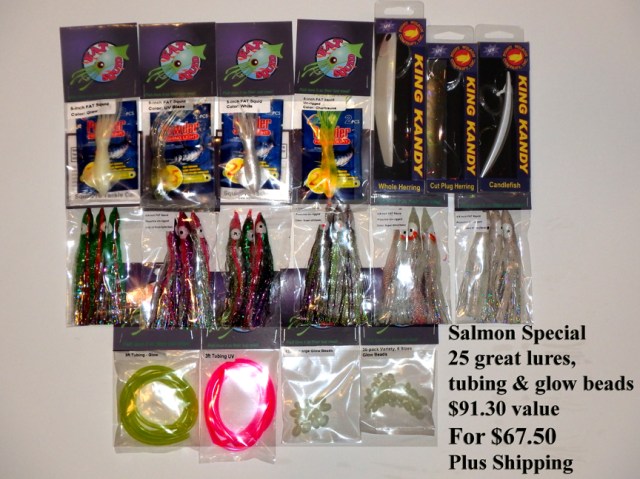
Salmon Special, 15 great salmon lures, tubing & beads

Click This Link to Order From Our Salmon Fishing Tackle Site > Salmon Lure Special

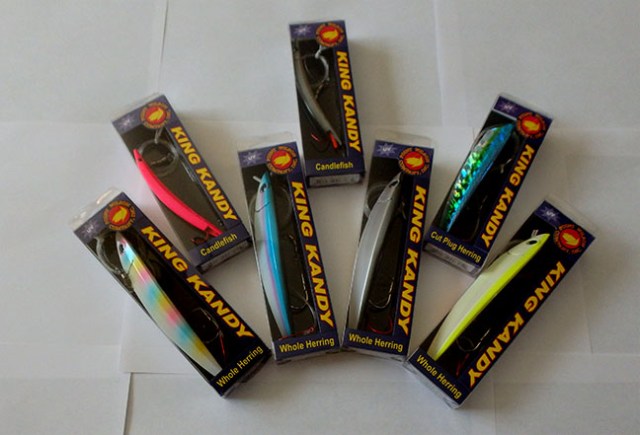
You can pay with any credit card through PayPal’s secure server. Orders will be shipped within one day of ordering unless ordered on Saturday, two days. Here’s what is included in the special. 4 mini FAT Squids, (glow, UV, white, chartreuse) 3 King Kandy lures (white hole herring, black chrome cut-plug, cop car candlefish) six three packs of Floochies. Each Floochie has a fly insert and all are either UV or Glow with Mylar and other enhanced fibers to attract salmon. (watermelon, UV purple glitter, UV green glitter, super UV, white, glow) glow tubing, UV tubing, two packages of glow beads. That’s 25 lures plus tubing and beads for just $67.50 plus shipping. To order click here >>>Salmon Lure Special

Posted in Uncategorized | Leave a comment

WDFW Rockfish Tagging Program

Posted in Uncategorized | Leave a comment

New Sensei Flex Rods

This spring my new line of rods will be here and should serve most angler’s needs. My most popular rod, the 6-foot, one piece blue series rod will be available again, but with a new name, Sensei Flex. There’s also a lingcod/rockfish/albacore rod, one piece jig rod, 9-foot downrigger rods & an IM6 8 to 20 pound 9-foot salmon/steelhead rod. Please watch this video showing my one piece jig rod, designed for sensitivity and strength. Whether you want a one piece rod for salmon or halibut, this rod will handle the duty.

Posted in Uncategorized | 1 Comment

Donald Trump & His Boys Support Public Lands

Posted in Uncategorized | Leave a comment

Will NOAA End All Fishing In Puget Sound To Save Endangered Rockfish?

Here’s an e-mail I received tonight, regarding the potential TOTAL CLOSURE of Puget Sound to any sport fishing. This is very serious, so please read this and comment to NOAA before we lose ALL sport fishing in Puget Sound.

Hello Everyone,

The purpose of this email is to make sure that everyone is paying attention to potential federal action concerning ESA listed rock fish that may have huge impacts on Puget Sound salmon fisheries.

These are the facts as I understand them, so please correct me if anyone has different information.

In about three weeks, NOAA is going to come out with an opinion on implementations to protect ESA listed rock fish. NOAA has already identified what it considers to be critical rock fish habitat.

NOAA Rockfish Protection Area

NOAA Rockfish Protection Area

The link below should take you to the critical habitat map for rock fish in Puget Sound.  You’ll see that MA 7-10 and the eastern part of 6 are pretty well high-lighted.  The map pretty well covers the proposed closure of MA 7-10.

Critical Habitat for Puget Sound/Georgia Basin Rockfish :: NOAA Fisheries West Coast Region

From what I understand, NOAA is suggesting that up to 30% of the critical habitat be set aside as no fishing zones. This means no fishing of any kind including salmon fishing, halibut fishing, crabbing or shrimping. Almost all near shore areas in Puget Sound as well as banks like Posession Bar are identified as critical habitat, but what 30% do you think they will home in on? These areas cover the most productive, traditional, and time honored salmon fishing areas. If these areas are closed I do not believe we will see them reopen within our lifetimes. I think this is the most important salmon management issue that we have faced in many years, yet it is not being adequately addressed by the Department in the NOF process or by the Advosory Group. We are discussing priorities about small closures of Shilshole Bay or Northern outer Hood Canal while ignoring a possible 30% closure in all areas.  How accurate will a fram model be if fishermen, both sport and commercial, can not fish where the fish are caught? How do you model that?

NOAA is still taking comment and input prior to it’s opinion. There will be an opportunity for public comment after NOAA has released it’s opinion. It may be much easier to have some effect on the opinion prior to it’s release. No take groups that want closures are putting pressure on NOAA and NOAA needs to hear alternative perspectives.

Questionable science and policy are being considered in the formulation of the opinion. A few are provided below, please respond if you have others.

1) According to WDFW rock fish manager NOAA determined that Puget Sound rock fish were a separate species from ocean varieties when it added three species to the ESA list. NOAA is currently collecting DNA from hook and line caught rock fish for DNA sampling to determine IF they are indeed a separate species from ocean varieties. I am taking part in this data collection. Why form opinions and take drastic action without having the facts?

2)  Not enough time has been given for the recent  very significant regulations already in place to take effect. Rock fish are a very slow growing species not reaching sexual maturity until age 8 and not being really good spawners until about 12 years old. Rock fish are a long lived species that can go years and years, even decades between successful spawns.This fact is leading to the possibility that successful rock fish spawns may be the most important factor in recovery.

3) The 120′ rule that is already in place protects far more habitat than the proposed 30%. It should be given a chance to work.

4) NOAA does not have all the current data it needs and is building with a mix of old data and Canadian data in formulating their opinion. If relying on Canadian data, it is important to note that in recent surveys of Canadian areas that were closed to all fishing due to rock fish protection NO change was observed in populations of concern. Why should entire closures be considered if closures have not been proven to be a success?

5) Recent examples have shown that rock fish that were released using descending devices have had a very high survival rate at depths that exceed rock fish by-catch encountered while salmon fishing.

6) Ongoing studies are showing that successful lingcod fisheries can be conducted with minimal rock fish encounters.

The next NOAA meeting for this topic is March 30.

We need to discuss this asap and we need to have our opinions heard.

Sincerely,

Steve Kesling

Posted in Uncategorized | Tagged , , , | 1 Comment

Central Puget Sound Summer Chinook (King) Salmon Season Cancelled in 2015

Washington State fish and wildlife will close Catch Area 10 this summer to sport fishing for Chinook salmon. According to several reports, the draconian measure will help rebuild Lake Washington king salmon runs.  Marine Area 10, from Dyes and Sinclair inlets to Seattle.

In 1999 several Chinook salmon stocks were listed as “Endangered” under the Endangered Species Act, including the Lake Washington run. Since receiving the Federal listing, these salmon runs have declined 25 percent.

Sport fishing groups opposed and objected to the closure while local tribal fisheries managers favored the measure saying this year’s warmer water temperatures, weather patterns and lost habitat will make this year a bad year for Chinook salmon.

One of the biggest problems, however, was not addressed — an overabundance of sea lions and seals. The tribes have the ability to legally “harvest” sea lions. In previous years, the Muckleshoots did try to get tribal members to participate in a sea lion harvest but nobody wanted to eat them.

Several years ago, while working for Western Outdoors Magazine, I was working on a story about Herschel and Hondo, the two most infamous sea lions at the Ballard Locks. Two old guys told me a story under the condition I not report their story. It has been years now and time for the truth, according to them to surface. They claimed their good friend, who passed away two years before Herschel became a problem at the Locks, took care of the problem. To keep my promise I won’t name names. The individual the two old guys told me about lived on the water where sea lions and seals now hang out in front of the Ballard Locks, dining on federally listed endangered Lake Washington salmon and steelhead.

“Before Seattle woke up, _____ would take his .22 rifle and shoot any sea lion or seal within his range. He’d shoot it in the head and then lungs, two quick, fairly quiet shoots.”

They also said he only shot them on an outgoing tide and claimed the old guy did this for years. They said his shot to the lungs sank the animals and the outgoing tide took away the bodies. Within two years of his death the sealions and seals took over and decimated Lake Washington Salmon and steelhead stocks.

Now today, the feds have a choice, take care of a sea lion and seal problem or end sport fishing, which is the more politically correct option.

The tribes are our answer, in my opinion. If we can work with the tribes and convince them to use their legal status to “remove” sea lions and seals, by any means, perhaps our endangered Lake Washington Chinook salmon might have a chance to recover. And yes, there’s lots of other problems facing these fish, which include poor ocean conditions, declining bait, loss of habitat, over harvesting etc.

In Washington State, the tribes “co-manage” fisheries. However, in my opinion and the opinion of many others, state fishery officials cave to their wishes, needs, and demands because they don’t want expensive battles that could end up in court. In other words, they cave in at the cost of sports anglers. Also note, the feds pressured Washington State fisheries managers to make this deal.

This is not the first time the fishery will be closed. In 2006 the state cancelled the Chinook season. And its not the first time the state caved in to tribal politics. Oh yeah, I forgot to mention, Tribal fisheries will not be affected by the ban this year.

Co-managing at its finest, punish one group in favor of another. Not fair! The fish sports anglers don’t catch will now swim into a wall of nets or into the hungry mouths of an over population of sea lions and seals, all of which will be waiting near the Ballard Locks.

The tribal fisheries will not be affected by the ban. Again I say, we need to do a better job of working with the tribes, convincing them to help restore Chinook stocks and reduce predation on our fish.

Posted in Uncategorized | Tagged , , , , | Leave a comment

2015 Washington Coastal Salmon Season Set

Pacific Fisheries Management Council Announces 2015 Washington Coast Sport Salmon Fishing Season

Coastal King SalmonA mark-selective Chinook season north of Cape Falcon begins May 30 off the Columbia
River and Westport, and May 16 off La Push and Neah Bay. This fishery ends June 12,
or when 10,000 marked Chinook are caught in all port areas combined.

The recreational fishery north of Cape Falcon opens to all salmon on June 13 and ends
September 30 or when Chinook or coho quotas are reached. The preseason coho quota
for all port areas combined is 150,800. For details, please see the season descriptions on
the Council website at http://www.pcouncil.org.

Washington and Northern Oregon (North of Cape Falcon)

Fisheries north of Cape Falcon (near Nehalem in northern Oregon) depend largely on
Columbia River stocks. Columbia River fall Chinook and coho returns are expected to
return at high levels. However, fisheries were constrained by measures to conserve
Chinook stocks in Puget Sound and coho stocks in the Queets River and the interior
Fraser River Basin.

North of Cape Falcon, there is an overall non-Indian total allowable catch of 131,000
Chinook and 170,000 marked hatchery coho.

Posted in 2015 Washington Salmon Seasons, LaPush Salmon Fishing, Neah Bay Salmon Fishing, Salmon Fishing, Washington Salmon Fishing | Tagged , , , | 1 Comment

King Kandy Salmon Fishing Lures – Hot New Colors for a Hot New Lure

King Kandy Fishing Lures

King Kandy in Hot New Colors

The 2014 fishing season brought about the introduction of the hottest new lure of the year – the King Kandy Plugs.  Invented by Dave Sanford of Sequim, WA who also invented Dungeness Stingers and the increasingly popular rotators, this plug was made by anglers for anglers and tested in the field for several years before production began.  This lure is all about catching fish.

King salmon, coho salmon, chum salmon and pink salmon love King Kandy lures.

King salmon, coho salmon, chum salmon and pink salmon love King Kandy lures.

Fish hit this high-action spinning lure hard and they hit it fast.  The lure barely hit the water before this salmon grabbed the hook.

fishing lures

The 3 styles of King Kandy in the popular Cop Car Color

For anyone who hasn’t yet tried the King Kandy it comes in 3 styles, Whole Herring, Cut Plug Herring, and Candlefish.  The whole herring and cut plug styles have an internal chamber with a sponge to soak up your favorite fish-catching scent.  You can find King Kandy online at kingkandylures.com.

candlefish plug

King Kandy Candlefish in Hot Pink

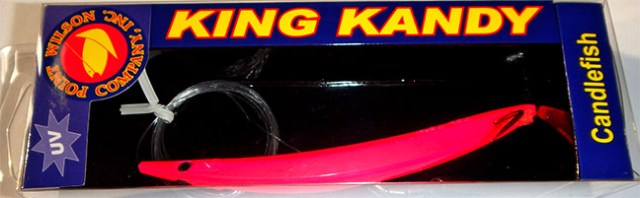
All the great colors from last season are back.  This year they are joined by 5 bright and colorful new choices.   The two smaller lures, candlefish and cut plug now come in hot pink.  Everyone’s favorite color for catching humpies.

high action fishing lure

King Kandy Cut Plug in Sardine

Blue and Green penetrate farther through the water column than most other colors, and the new sardine color has both.   Fish may hit blue, green, or chartreuse lures more on an incoming tide.  It’s good to keep a variety of colors on hand because the colors fish hit can change with the tides as well as the amount of light in the water, the location of the fishing hole, and the life stage of the fish.

brightly colored fishing lure

King Kandy Whole Herring in Wonder Bread color

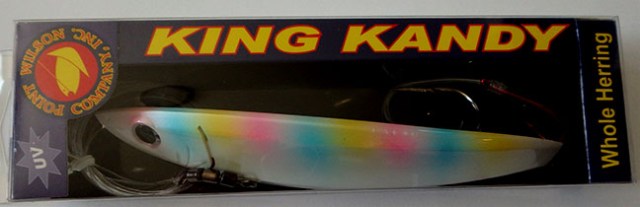
On an outgoing tide fish may prefer something more colorful like the new wonder bread King Kandy lure.  Mature fish also like bright colors.

fishing lures

King Kandy Whole Herring in Chartreuse

When visiting a new area or even just starting on a familiar one at the beginning of the day, using colors like chartreuse or the old standby white gives you a good chance to catch something and find out what’s there.

catch more fish

King Kandy Candlefish in Blue Pearl

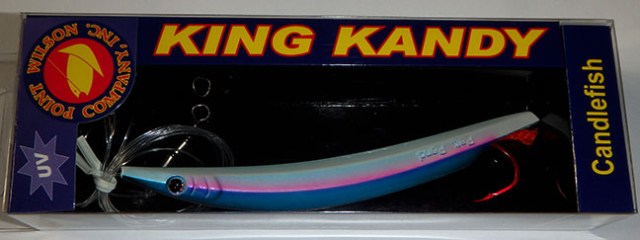
Blue Pearl has been a favorite color of the Point Wilson Darts for many years for one reason – it works.  Now Blue Pearl is available in the King Kandy too.  Whichever colors you choose one thing is for sure – if the fish are out there having King Kandy on the boat increases your odds of catching them.

Posted in How to choose lure colors, Salmon Fishing, Salmon Fishing Tackle, Salmon Fishing Tips & Tricks, Washington Salmon Fishing | Tagged , , , , , , , , | 1 Comment